Spot UV Business Cards Printing Comparison Review! (Printing Companies in Japan)
- Dec 21, 2025
- 21 min read
This time, a designer from LITTLE FUJI actually ordered their own business cards from two different printing companies. In this post, I will share a comparison review based on the companies’ customer service, pricing, and the final finish of the spot UV business cards!
Why Did I Need Business Cards in the First Place?
I am a graphic designer based in New Zealand, and most of my communication with clients is completed online. To be honest, in today’s digital world, I did not feel a strong need for business cards.
However, as I was planning a temporary return to Japan, I knew I would be meeting clients and work partners in person and attending networking events for freelancers.
That was when I thought it would be a good opportunity to create business cards while I was back in Japan.
In New Zealand, it is rare to receive business cards directly, but I often see them placed in cafes or supermarkets for people to pick up.
If the opportunity arises, I may also try leaving a few of my own business cards in similar places.
Why I Chose to Print the Same Design With Two Companies
This year, I also had opportunities to design business cards for work.
By physically holding business cards printed by companies I have used professionally, I felt it would be valuable to check the quality of the final output and apply that knowledge to future projects.
Especially for graphic design items such as business cards, flyers, and brochures, the process does not end with design alone.
Until the design is printed and becomes a physical object, it is difficult to fully understand the actual colors and finish.
By experiencing the texture of printed materials, special finishes like spot UV business cards, color tones, and text size firsthand, I can better explain to clients which printing company may be suitable and what kind of finish or color outcome they can expect.
With that in mind, I decided to order the same business card design from two different printing companies and compare the results.
【Case Study】Business Card Design for LITTLE FUJI Design Studio
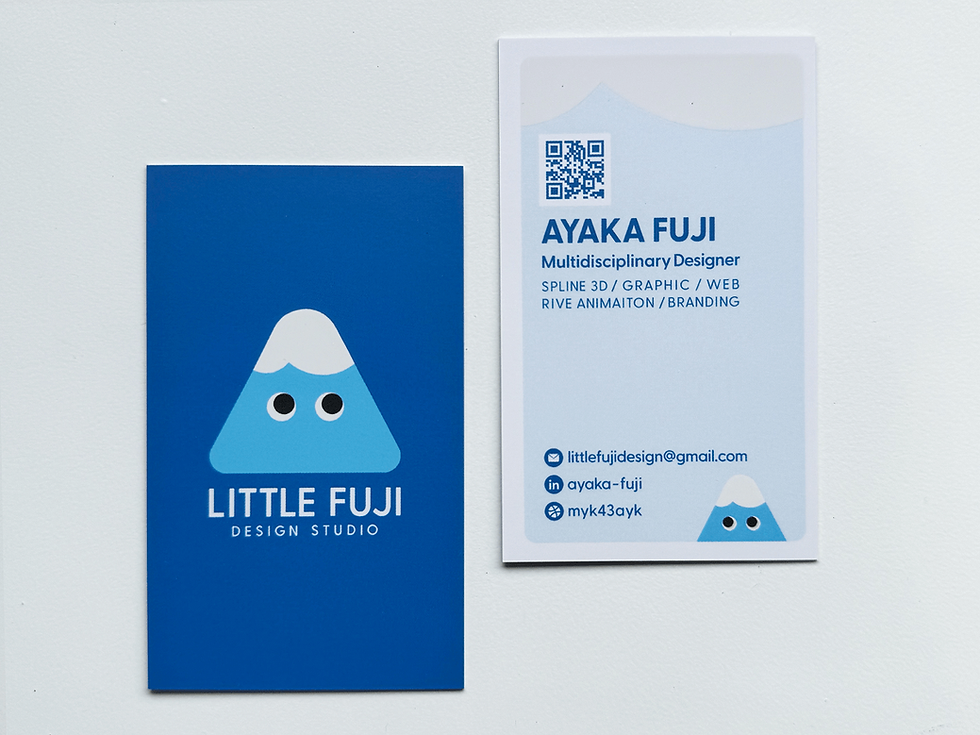
Here is the design I created for this project 👇

LITTLE FUJI Design Studio is a design studio based in New Zealand. Since most of our clients are from New Zealand, Australia, and the United States, all the information on the business card was created in English.
The business card size is the standard Japanese size of 55mm × 91mm.
It is a vertical layout, full color, double sided business card.
This design example was also used to review print quality and finishing, including spot UV business cards, by comparing the same design printed by different printing companies.
Front Side Business Card Design

The front side features a simple design with only the square LITTLE FUJI Design Studio logo.
I wanted the first impression to be memorable and feel friendly, so I settled on a minimal design using only the logo.
Many people easily associate the keywords FUJI with Mt. Fuji and Japan.
I designed the card to communicate LITTLE FUJI’s brand identity of being playful, simple yet unique.
When I actually handed out the business cards, many people reacted with comments like “So cute!” or “It is Mt. Fuji 😆!?” as their first response.
That made me feel that the design intention was successfully achieved.✌
This simple front design also works well with finishes such as spot UV business cards, where the logo can stand out through texture and contrast.
My last name is Fuji, so this design also serves the purpose of making my name easier to remember.
Back Side Business Card Design

The back side of the business card is dedicated to contact information.
A QR code linking to the website is included, and my name is placed in the largest size to ensure clarity and visibility.
I spent quite a lot of time to decide the job title😅. Since it is already clear from the design studio name and the logo on the front side that I am a designer, I assumed that part would be communicated naturally. With that in mind, I chose the wording “Multidisciplinary Designe,” which I usually use on social media.
Because I work across a wide range of design fields, I added keywords that represent the areas I am most confident in and the design directions I want to focus on in the future as supplementary information.
For contact details, I included my website, email address, LinkedIn, and dribbble.
I struggled quite a bit with the layout and content of this back side design. I created several variations, placed them side by side for comparison, and asked multiple friends and family members to review them.
In the end, I selected the design that received the highest number of votes.

This back side layout was also designed with finishes such as spot UV business cards in mind, so that key elements stand out clearly while keeping the information easy to read.
Since the email address icon is universally recognizable at a glance, I mainly expect leads to come either from visiting the website via the QR code or through direct contact using this email address.
I do have multiple social media accounts, but I chose to include only LinkedIn, which I actively use, and dribbble, which is well known among overseas creative agencies and designers and where I personally have a solid number of followers.
For reference, I have introduced dribbble in more detail in this article, so if you are interested, please take a look 👇

Two Japanese Printing Companies I Used for Spot UV Business Cards
From an early stage, I had already decided to add a special finish to the business cards.
Even though the design itself was simple, I wanted to express a sense of playfulness and individuality through the printing technique.
There are many types of special finishes available for business cards, such as foil stamping, laser cutting, and translucent or skeleton style cards made with semi transparent paper.
This time, I wanted to create business cards that people would instinctively want to touch, so I chose to add a raised glossy finish - which is called "Spot UV Business Cards".
When I searched online, I found that there were not many Japanese printing companies that offer this type of glossy raised processing.
For this project, I decided to use two printing companies in Japan, Meishi21 and Card One, and ordered spot UV business cards from both to compare the results.
Meishi21 Website👇
Card One Website👇
Meishi21 was introduced to me by another designer.
I have actually used this printing company before for client business card projects, and my impression is that their pricing is reasonable and they also handle urgent printing and delivery requests.
Card One was a printing company I used for the first time.
I found them while searching for raised glossy finishes for business cards, which was the main purpose of this project.
They appeared high in search results, and their production examples featured many beautifully designed works, so I decided to place an order with them.
Compared to other companies, the pricing felt slightly higher.
However, they offer a wide range of special printing options, so my impression is that they are well suited for people who want to create distinctive designs and premium finishes such as spot UV business cards.
Cute and Unique Glossy Texture!?What Is UV Spot Business Cards?
Spot UV business cards are referred to by different names depending on the printing company. In addition to the commonly used term “UV Spot Business Cards” I also came across names such as SPOT Gloss UV Business Cards and Embossed Gloss Business Cards. *In japanese, we call "Tsuyamori-Kakou".
This special finish is created by applying a transparent varnish on top of the printed design.
The coated areas become slightly raised with a soft, tactile feel, and depending on the angle, you can enjoy a glossy reflection of light.
Because the varnish is transparent, it can be used subtly as a small accent or layered as patterns or textures over the design.
I felt that this type of finish perfectly matched LITTLE FUJI’s branding of being simple yet playful, which is why I chose spot UV business cards for this project.
For more detailed information about this type of UV Spot Business Cards, the explanation page by VIsta Print is very clear so feel free to check it out if you are interested 👇
Important Points to Note When Creating Spot UV Business Cards
There are several important points to be aware of when adding a glossy raised finish to business cards.
Not every business card design is suitable for this type of processing.
The conditions and requirements for spot UV business cards vary depending on the printing company.
However, the two companies I used for this project shared similar precautions and guidelines, as outlined below.
【Notes on Glossy Raised Processing by Meishi21】
※Meishi21 offers two types of glossy raised processing, called partial coating printing and epoxy emboss printing. For this project, I used partial coating printing.
Partial coating printing creates a smooth surface finish. Because the coating is applied on top of matte PP lamination, shadows are more noticeable and the glossy effect is easy to see.
This processing is available for business cards, postcards, double fold business cards, reply postcards, product tags, and die cut cards.
Partial coating printing is only supported on Matte Coat 258kg paper.
The minimum order quantity is 100 cards, with a turnaround time starting from 5 business days.
For print data submission, the areas to be processed must be specified on a layer named “Kakou” using K100 percent.
For more details about Meishi21’s spot UV business cards, please refer to the website below.
Introduction to spot UV business cards printing and epoxy emboss printing
【My Printing Order for the Spot UV Business Cards from Meishi21】
The actual specifications for the business cards I ordered from Meishi21 are as follows.
*There was no specific delivery date requested.
Paper type: Matte Coat 258kg with matte PP lamination
Color: Full color on both sides
Special finish: spot UV on both sides
【Submission Data for Meishi21 Spot UV Business Cards】
The submission data for Meishi21 is prepared in this way.

The areas to receive special processing are specified using a K100 percent layer, which is solid black.
Any area filled with solid black on this layer will receive the special finish.
Both the front and back designs are included within a single Adobe Illustrator file.
【Notes on Spot UV Processing by Card One】
When applying spot UV processing, the coated area must be placed at least 1mm away from the trimming edge. If the spot UV layer overlaps the cut line, it may crack or peel after trimming.
Very small text or intricate illustrations may become crushed or uneven. For this reason, it is recommended to apply spot UV processing on top of already printed text or graphics rather than relying on fine details alone.
If the spot UV area covers a large surface, air bubbles may occur during processing.
The varnish used for spot UV business cards is not completely transparent. The processed areas may appear slightly yellowish. This yellow tint can be more noticeable when the printed design underneath is white.
Double sided spot UV processing is available only as a custom order and requires consultation in advance.
At Card One, applying spot UV processing to both sides of a business card is handled as a custom order rather than a standard website purchase.
I contacted them directly to discuss the specifications and receive an individual quote.
In practice, true double sided spot UV processing is not available as a single sheet option at Card One.
Instead, they offer a method where two single sided spot UV business cards are bonded together to create a double sided finish.
As a result, the cost is higher, and the final business card becomes noticeably thicker.
【Printing Specifications of the Spot UV Business Cards I Ordered From Card One】
There were no specific notes regarding paper restrictions, so I placed the order for spot UV business cards with the following specifications. No specific delivery date was requested.
Paper type: Coated card paper 180kg with matte PP lamination
Color: CMYK printing on both sides
Special finish: Spot UV processing on both sides, created by bonding two single sided spot UV cards together
【Submission Data for Card One Spot UV Business Cards】
The submission data for Card One is prepared in a similar way to Meishi21.
The areas to receive spot UV processing are specified using a K100 percent layer filled with solid black.

For Card One, I separated the front and back designs into two Adobe Illustrator files.
How Long Does It Take From Ordering Business Cards to Delivery?
Since I wanted to use the business cards for networking events and business dinners, I finalized the design and prepared the print data about two and a half weeks before the date I planned to use them.
Timeline From Order to Delivery for Spot UV Business Cards From Card One
I placed my first order with Card One.
The detailed timeline from order to delivery is shown below.
When counting only business days and excluding weekends, the business cards arrived five business days after placing the order.
*The delivery destination was within the Kanto region.

I received a reply from the person in charge the day after I sent my inquiry, along with a quote for a custom order.
As soon as I replied to confirm the quotation details, I received another prompt response, then completed the payment on the same day using the provided payment link.
After sending the print data by email later that day, I was informed the next day that the order had moved into the printing process. At that point, I was told that delivery would be completed by the 18 day after placing the order.
The website stated that orders would be shipped 8 business days after order confirmation, with a submission deadline of 12 pm.
Because of this, I felt that the timeline was longer than expected and started to worry that the business cards might not arrive in time for the networking event where I planned to use them. (;´・ω・)
However, the information on the website applied to single sided special processing only. 😅 Since my order was a custom order with spot UV business cards on both sides, this may have affected the schedule.
I then contacted the person in charge again to ask whether the delivery date could be brought forward, even if there was an additional charge.
I received a reply saying that the cards were already completed and were scheduled to be shipped either that day or the following day.
In effect, this meant that the printing process was completed 6 days after the order date and had already moved into shipment preparation.
Exactly 7 days after placing the order, I received a shipping notification, and the business cards were delivered to the destination the following day.
The person in charge may have intentionally given a conservative delivery estimate, but to be honest, it was a bit stressful not knowing whether the cards would arrive in time. 😅
This experience reminded me once again that printed materials require extra time and that designs and print data should always be finalized and submitted well in advance.
For reference, when ordering from Card One, the business cards arrived via Letter Pack.
They were packed in branded boxes like this. I ordered 100 cards, and the package contained a total of three boxes.

Timeline From Order to Delivery for Spot UV Business Cards From Meishi21
The next order was placed with Meishi21.
When counting only business days and excluding weekends, the business cards arrived 6 business days after placing the order.
In this case, the delivery destination was Okinawa, where I was staying at the time.
The package was delivered to Haneda Airport 5 business days after the order, and it arrived in Okinawa on the 6 business day, which was a Saturday.

Since I had used Meishi21 in the past, I already had an account, which made the data submission process relatively smooth.
The spot UV option, partial coating on both sides, could be ordered directly through the website.
As a result, there was no need to communicate with a person in charge.
I simply uploaded and checked the print data on the Meishi21 website and completed the payment online.
Because the order was placed j1st before the weekend, I received the order confirmation email after effectively 1 business day, along with a notice that the printing process had started.
Three business days later, the printing process was completed and I received a shipping notification. Meishi21 shipped the spot UV business cards using Yamato Transport’s Nekopos service in Japan.
Since the delivery destination was Okinawa, the package arrived 8 days after placing the order.
If the destination had been within mainland Japan, I believe it would have arrived in 7 days.
The Meishi21 package arrived in two boxes, and business card samples were included inside the boxes.

In the end, business cards from both Card One and Meishi21 were delivered in about one week from the order date.
In terms of delivery speed, I was completely satisfied with both services.🙂
Finish Review of Spot UV Business Cards
From here, I will compare the spot UV business cards that actually arrived and share my personal impressions and review from a designer’s perspective.
Finish of Spot UV Business Cards From Card One
First, let’s take a look at the spot UV business cards from Card One.
My first impression was very positive.
The raised, plump texture of the spot UV business cards was clearly noticeable, and the thickness of the cards also felt substantial and premium.💖
One point that stood out to me was a slight misalignment in the printing on the back side.
In the submission data, the layout was designed so that the left and right margins were evenly balanced.
However, on the actual printed cards, the elements appear to be shifted slightly to the right, resulting in uneven margins on both sides.
Review for the Spot UV Areas
Because the cards also have matte PP lamination, the paper itself has a smooth and dry texture. In contrast, the spot UV areas have a raised thickness, creating a tactile finish that makes you want to trace it with your fingers.
It can be difficult to see the processing clearly in photos taken from the front. However, when viewed from an angle, the spot UV areas become very noticeable.
On the front side, spot UV processing was applied to the white area at the top of the Mount Fuji motif and to the eyes.
On the back side, spot UV was applied to the decorative element at the top, as well as to the Mount Fuji head and eyes at the bottom.

It is a little difficult to see in photos, but when holding the cards in hand, the glossy areas are immediately noticeable.
I had read that white areas can sometimes show a yellowish tint from the varnish, but at first glance, it did not bother me at all.
Especially on the front side, the spot UV business cards look clean and clearly glossy with a transparent finish.
On the back side, the decorative element at the top does appear slightly yellowish when placed next to the Meishi21 cards, which I will introduce later.
However, when viewed on its own, the difference is barely noticeable.
Thickness of the Business Cards from Card One
Because the cards are bonded together, each business card has a solid and substantial thickness, which gives a slightly luxurious impression.
Thin and flimsy paper can feel cheap, so this thickness is something I personally really like.
When I actually handed the spot UV business cards to people, I even got reactions like “Oh wow, this paper is thick and rich,” which made me smile.😋

Colour Accuracy of the Finish
The colours were reproduced faithfully according to the submitted print data, and the final result met my expectations.
The colours are consistent between the front and back sides, resulting in a clean and well balanced finish overall.

Price of the Spot UV Business Cards Ordered From Card One
For this order, I printed 100 business cards with full colour on both sides and spot UV processing as a custom order.
The total cost at Card One was 26,700 yen. (About NZD 300)
To be honest, my first impression was that it was quite expensive.
However, the finish of the spot UV business cards and the colour quality were extremely satisfying.
Because of this, I feel that these cards are well suited for situations where you want to focus on a highly detailed design using special finishes, or for important clients and events where you want to make a strong impression.
If it were not for the slight printing misalignment where the design shifted a little to the right, the result would have been perfect.(´;ω;`)
Finish of the Spot UV Business Cards From Meishi21
Next, I will share the finish of the spot UV business cards from Meishi21.
When comparing them with the Card One cards that arrived earlier, my first impression was that the colour tone felt slightly different.
When compared with the original print data, the colours appear a little deeper and darker than the specified values.

Finish of the Spot UV Areas盛り加工部分の仕上がり
The partial coating used by Meishi21 has less thickness, with only a very subtle raised effect.
The surface of the spot UV areas also appears slightly uneven. It is not noticeable at first glance, but depending on the viewing angle, you may notice it.
Compared to Card One, I felt that the reflection of light was slightly more noticeable on the Meishi21 spot UV business cards.

On the back side, the decorative element at the top shows no yellowing compared to Card One, and the transparent varnish has been applied cleanly and evenly.
Thickness of the Business Cards
The thickness of the business cards feels like a standard business card weight.
Unlike Card One, which uses bonded layers and results in roughly double the thickness, these cards are not bonded and have a slimmer feel.

Because matte PP lamination is also applied, the surface of the paper has a smooth and dry texture.
The cards do not feel bulky when placed in a card holder, yet they are not so thin that they feel flimsy.
Overall, they feel easy and comfortable to carry, even as spot UV business cards.
Colour of the Final Finish
One point that stood out to me with the Meishi21 business cards was the final colour result.

On the front side, the background colour appears only slightly darker than expected.
However, the back side felt noticeably darker and more muted than the colour I had originally intended.
Since the same colour is used on both sides, the light blue of the Mount Fuji icon and the front background colour which is also used as the text colour on the back side, the difference becomes immediately obvious when comparing the front and back.
Because this difference was noticeable, I contacted Meishi21 to ask about it. According to their explanation, this is due to their gang printing method.
On the Meishi21 website:
There is also a note stating that colours may be influenced by adjacent print data during gang printing. As a result, slight colour variations may occur, and it is not possible to guarantee exactly the same colour reproduction every time, even when using the same data. Meishi21 gang printing (https://www.meishi21.jp/Technical/Kouhan)
This method appears to be intended to reduce the number of printing plates, paper usage, and ink consumption.
However, from a designer’s perspective, colour accuracy is something I care deeply about and is also very noticeable in the final result.
Because of this, I felt that some extra consideration may be needed at the design stage when creating spot UV business cards with Meishi21.
Price of the Spot UV Business Cards Ordered From Meishi21
For this order, I printed 100 business cards with full colour on both sides and partial coating. The total cost at Meishi21 was 4,200 yen. (About NZD46!)
To be honest, I was surprised at how inexpensive it was.
Considering that spot UV business cards with special processing on both sides arrived in about one week, I think this is a very reasonable price.
However, because Meishi21 uses a gang printing method, the difference in colour between the front and back sides is something to be aware of.
What I Learned From Comparing Two Printing Companies for Spot UV Business Cards
This time, I ordered spot UV business cards from two Japanese printing companies, Card One and Meishi21.
Based on this experience, I summarised my thoughts on delivery time, price, and final quality using a five star rating system.
Card One | Meishi21 | |
Delivery Time From Order to Arrival | ★★★★★ | ★★★★★ |
Price Per 100 Cards | ★★☆☆☆ | ★★★★★ |
Colour Reproduction and Final Colour Finish | ★★★★★ | ★★★☆☆ |
Quality of the Spot UV Processing | ★★★★★ | ★★★★☆ |
Printing Alignment Accuracy | ★★★★☆ | ★★★★★ |
Comparing Delivery Speed and Price
When comparing delivery speed, there was almost no difference between the two companies.
From order to arrival, both delivered the business cards in around 5 to 6 business days, which felt faster than expected.
There was a significant difference in price.
For the same type of special processing, Card One charged 26,700 yen (NZD 300), while Meishi21 charged 4,200 yen (NZD 46).
This means Card One was roughly 60% more expensive than Meishi21.
However, when it came to other factors such as overall finish and quality, I personally felt more satisfied with Card One.
If you want to invest in spot UV business cards and prioritise accurate colour reproduction and a finish that closely matches your submitted design data, Card One may be the better choice.
On the other hand, if you can accept slight colour variations and simply want something fast and affordable, Meishi21 is likely the better option.
When special processing is not required, some paper types at Meishi21 can even be shipped within three business days.
Comparing Colour Reproduction of the Finished Business Cards
Let’s compare the colour results side by side. The card on the left is from Card One, and the card on the right is from Meishi21.

When placed next to each other, the business cards ordered from Card One show a bright and clean blue that is almost identical to the colour specified in the submitted print data.
In contrast, the Meishi21 cards appear closer to a navy blue tone and are slightly darker than the original colour setting.
When comparing the back sides, the Meishi21 cards also show deeper and darker colour reproduction.
I briefly thought that this darker tone might actually work well for text.
However, since the same colour is used for the FUJI icon in the brand logo, the difference becomes very obvious.
From a designer’s perspective, having a logo colour that visibly differs from the intended shade is something I found difficult to overlook.

Regarding print alignment, the Card One cards show slightly more noticeable misalignment, with the design shifted to the right.
The Meishi21 cards did not show this issue and were neatly centred with balanced left and right margins.
I believe the print misalignment seen in the Card One cards may be due to the custom order method where the front and back were bonded together.
If the design were single sided, or if it used a layout where small margin differences are less noticeable, such as full bleed designs without frames or borders, this issue could likely be reduced.
For Meishi21, I feel it is important to inform clients in advance that colour differences may occur between the submitted data and the final result when ordering spot UV business cards.
Comparing the Quality of the Spot UV Finishing
Next, let’s look at the most important point of this comparison, the quality of the spot UV processing.
In this area, I personally felt more satisfied with the finish from Card One.


The spot UV processing from Card One has a clearly raised thickness, with a very smooth and even surface.
There is no visible unevenness, and the finish is extremely clean. The spot UV areas are clearly noticeable even when viewed from the front, giving a strong and polished impression.
With Meishi21, the spot UV areas have less thickness, and the surface feels slightly uneven.
At first glance, it is harder to tell that spot UV processing has been applied when looking straight on.
However, when viewed from an angle, the glossy reflection becomes more visible.
Most importantly, considering the price point, the quality is more than acceptable, and being able to add special processing at this cost offers excellent value for money.
Comparing the Thickness of the Business Cards
Finally, let’s compare the thickness of each business card side by side. In the photo, I lined up ten cards from each company for comparison. *Photo assistance by Quagsire and Slowpoke.

When placed next to each other, the difference is immediately clear.
The business cards from Card One are about one and a half times thicker than those from Meishi21.
You could think of the Card One cards as having a backing board like thickness.
The paper types used are different, with Card One using coated card paper 180kg and Meishi21 using matte coat 258kg.
In addition, Card One bonds together two single sided spot UV cards, while Meishi21 uses a gang printing method, so differences in the printing process also affect the final thickness.
Personally, I really like the solid and substantial feel of the Card One cards.
That said, the thickness of the Meishi21 cards does not feel lacking at all.
They also fit neatly into a card holder without adding bulk, so this point ultimately comes down to personal preference.
Meishi21 Offers Free Paper Samples
Meishi21 allows you to request free samples of all the paper types they offer.
Meishi21 list of available paper types
At Card One, paper samples can be requested for a fee, starting from 2,000 yen for 5 paper types.
Card One enquiry page
Both companies support more than fifty types of paper, so taking the time to carefully choose the right paper for spot UV business cards sounds like an enjoyable part of the process.
Summary of the Comparison of Spot UV Business Card Printing Companies
Based on my experience as a designer who actually placed orders with both companies, my conclusion is as follows.
If you want to invest in your budget and create unique business cards that stand out from others, with a strong focus on special finishes and distinctive design, I would recommend Card One.
If you prioritise value for money and want business cards that are as affordable and fast as possible, while still having the option to add special finishes, Meishi21 is a great choice.
This became the overall result of my review.なりました。
In particular, Card One offers a wide range of special finishes that are rarely seen at other printing companies.
Even among popular special processes such as foil stamping, they provide unique options like Tokutoku Cushion Business Cards with foil stamping on cushion paper, Hand Dyed Yuzen Washi Business Cards that would suit traditional Japanese style designs, Upe Business Cards made with velvet flocked paper, and Vibelle Business Cards with a soft wool like textured surface. If these materials align with your brand identity, they have the potential to create highly distinctive spot UV business cards and business card designs that are truly one of a kind.
See the list of special finishes offered by Card One here 👇
On the other hand, Meishi21 stands out for its very affordable pricing and is highly recommended for those who prioritise value for money.
I previously ordered foil stamped business cards from Meishi21, and the finish was good and well received by my clients at the time.
In terms of special finishes, Meishi21 offers options such as foil stamping and embossing, as well as fluorescent business card printing with vivid and distinctive colour reproduction.
They also support folded formats such as bi fold and tri fold business cards.
In addition to business cards and spot UV business cards, Meishi21 also produces a wide range of printed items and goods, including badges, stickers, product tags, coasters, and magnets.
This makes them a great option if you want to order business cards together with branded goods or promotional items in one place.
Meishi21 Website👇
LITTLE FUJI Offers Business Card Design Services!
At LITTLE FUJI, we provide business card design services, including designs that incorporate special finishes like spot UV business cards, as introduced in this article.
A Japanese designer based in New Zealand will propose business card designs that match your preferences and brand image.
We also support the entire process from print data preparation to printing and delivery arrangements within Japan.
Please feel free to contact us if you are interested or would like to discuss your project.

We also have extensive experience in creating flyers and brochures using PowerPoint and Adobe Illustrator.
You can view these production works under our other brand name, PHAINO DESIGN, at the link below 👇
※Please note that for customers outside Japan, we currently offer business card design only, and the final delivery will be print ready data.
In the future, I am planning to place orders with printing companies in New Zealand and Australia as well.
If I can also support printing and submission locally, that would be ideal. I hope to place orders with several companies soon and share comparison and review articles again.
If we happen to meet in person, I will likely be carrying the business cards I created this time, so please feel free to say hello 😊


